Understanding Timber Ratings and Classifications

The Durable Hardwoods guide to interpreting technical ratings and choosing timber that performs beautifully for decades.

Durability class, hardness ratings, fire resistance, BAL classifications—understanding these rating systems is essential for selecting the right hardwood for your project. This FAQ explains what each rating measures, how to interpret the numbers, and most importantly, how to use this information to choose timber that matches your application's specific requirements. From decking and flooring to structural applications and bushfire-prone areas, we'll help you decode the technical specifications and select with confidence.

Durability Class Ratings

What is the Durability Class rating system?

The Durability Class rating system measures a timber species' natural resistance to decay and biological deterioration when exposed to weather and ground contact. This classification helps you select the right hardwood for your specific application, particularly for external or exposed uses.

The system ranges from Class 1 (most durable) to Class 4 (least durable):

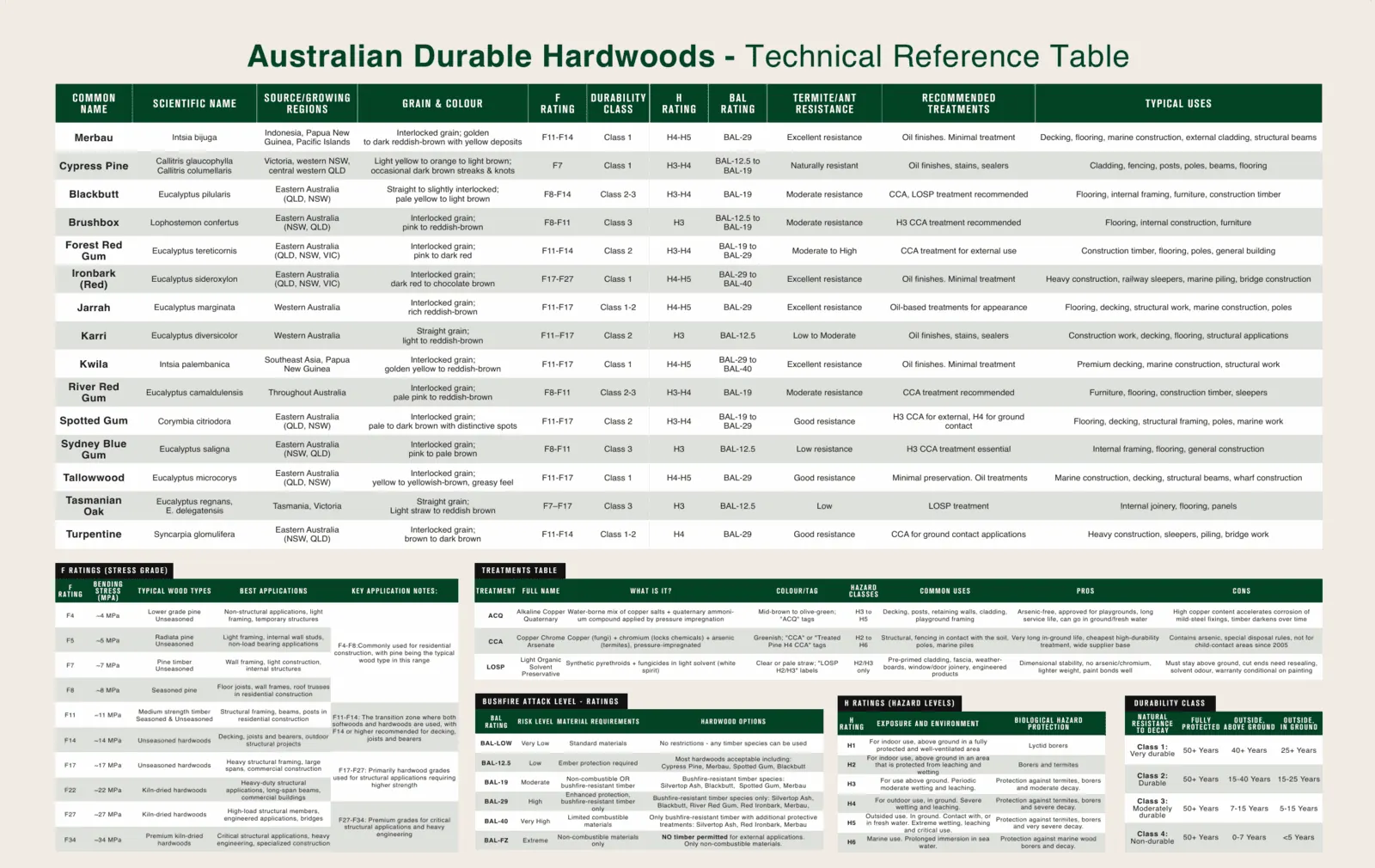
  • Class 1 - Very Durable: Expected life exceeding 25 years in ground contact, 40+ years above ground. Species like Merbau, Ironbark (Red), Kwila, and Tallowwood fall into this category—ideal for decking, marine construction, and heavy structural applications without treatment.
  • Class 2 - Durable: Expected life of 15-25 years in ground contact, 15-40 years above ground. Spotted Gum, Blackbutt, and Jarrah are examples. Excellent for flooring, decking, and structural framing with minimal or no treatment required.
  • Class 3 - Moderately Durable: Expected life of 5-15 years in ground contact, 7-40 years above ground. Species like Brushbox, Sydney Blue Gum, and Tasmanian Oak. Suitable for internal construction and flooring, but require treatment for external or ground contact applications.
  • Class 4 - Non-Durable: Expected life under 5 years in ground contact, 0-15 years above ground. Generally requires treatment for all external applications.


How do I use Durability Class ratings to choose timber?

Match the Durability Class to your application's exposure level:

  • For decking, external cladding, or marine construction: Choose Class 1 or Class 2 species like Merbau, Ironbark, Spotted Gum, or Blackbutt. These species have the natural oils and dense structure to withstand weather exposure with minimal maintenance.
  • For flooring and internal framing: Class 2 or Class 3 species work excellently. Blackbutt, Spotted Gum, Brushbox, and even Tasmanian Oak are suitable as they're protected from direct weather exposure.
  • For ground contact (posts, poles, sleepers): Only Class 1 or Class 2 species, or use treated timber. Even durable species benefit from CCA treatment for ground contact to maximize service life.


At Durable Hardwoods, we help you match species durability to your project requirements, ensuring optimal performance and longevity.

Hardness Ratings (Janka Scale)

What does the Hardness (H) Rating mean?

The Hardness Rating uses the Janka hardness test, which measures the force required to embed an 11.28mm steel ball halfway into timber. The result is expressed in kilonewtons (kN) and indicates the timber's resistance to wear, denting, and damage.


The rating system is:

  • H1: Less than 4.5 kN (softwoods, very soft hardwoods)
  • H2: 4.5-5.5 kN (soft hardwoods)
  • H3: 5.5-7.0 kN (medium hardwoods)
  • H4: 7.0-9.0 kN (hard hardwoods)
  • H5: Greater than 9.0 kN (very hard hardwoods)
  • H6: Greater than 12.0 kN (extremely hard—rare)

How do I interpret Janka hardness ratings for my project?

For flooring applications:

  • High-traffic commercial or family homes: Choose H4-H5 species (7.0+ kN) like Merbau (H4-H5), Ironbark (H4-H5), Jarrah (H4-H5), or Spotted Gum (H3-H4). These resist denting from furniture, foot traffic, and dropped objects.
  • Moderate-traffic residential: H3-H4 species (5.5-9.0 kN) like Blackbutt (H3-H4), Brushbox (H3), or Sydney Blue Gum (H3) provide good durability with beautiful aesthetics.
  • Low-traffic areas: H2-H3 species may suffice, though harder species still offer longer life.
  • For decking: Hardness matters less than durability class for decking since weather resistance is the primary concern. However, harder species (H3-H5) will resist traffic wear and maintain their appearance longer.
  • For structural applications: Hardness indicates density and generally correlates with strength. H4-H5 species provide superior structural performance for beams, posts, and heavy construction.

  • Example from our range: Ironbark (H4-H5) at 14.0 kN is approximately twice as hard as Tasmanian Oak (H3) at 5.5 kN, making it far more resistant to wear in demanding applications.


Can timber be too hard?

While extreme hardness (H5-H6) offers maximum durability, it can present challenges:

  • Requires pre-drilling for all fasteners to prevent splitting
  • Harder to cut and work with, slowing installation
  • May be unnecessarily expensive for low-wear applications
  • Can be more brittle under impact


At Durable Hardwoods, we help you select timber that's hard enough for your needs without being difficult to work with. For example, Spotted Gum (H3-H4) offers an excellent balance of hardness, workability, and appearance for most flooring and decking applications.

Fire Resistance Ratings

What do the Fire Resistance (F) ratings indicate?

Fire Resistance ratings classify timber's behavior when exposed to fire, based on ignitability, spread of flame, heat evolved, and smoke developed. These ratings are critical for building code compliance in bushfire-prone areas and certain commercial applications.

  • F27: Highest fire resistance (very rare in timber)
  • F14: High fire resistance—species like Merbau, Blackbutt, Tallowwood, and Turpentine
  • F11: Good fire resistance—species like Brushbox, River Red Gum, and Sydney Blue Gum
  • F7: Moderate fire resistance—Cypress Pine, Tasmanian Oak
  • F17: Standard fire resistance (most common rating)

How does timber perform in fires compared to other materials?
Timber in fire:
  • Forms a protective char layer on the outside
  • Char insulates the interior, slowing further burning
  • Burns at a predictable rate (approximately 0.6-1.0mm per minute for hardwoods)
  • Retains structural integrity longer than might be expected
  • Engineers can calculate char rate and design accordingly

  • Steel in fire:

  • Loses strength rapidly at high temperatures (loses 50% strength at 550°C)
  • Can collapse suddenly without warning
  • Requires fire protection (boarding or spray coatings) in many applications

  • Dense Australian hardwoods from Durable Hardwoods perform particularly well due to their high density and low moisture content, which slow combustion rates.


BAL Ratings (Bushfire Attack Level)

What are BAL ratings and why do they matter?

BAL (Bushfire Attack Level) ratings define the level of bushfire attack a building site may experience, based on distance from vegetation, fire danger index, vegetation type, and slope. Australian Standard AS 3959 establishes six BAL categories:

BAL-LOW: Insufficient risk to warrant specific construction requirements. Very low risk of ember attack.
BAL-12.5: Low risk. Increased risk of ember attack. Basic bushfire construction requirements apply.
BAL-19: Moderate risk. Increased risk of ember attack and burning debris ignited by windborne embers. More stringent construction requirements.
BAL-29: High risk. Increased risk of ember attack and exposure to radiant heat. Significant construction requirements including material specifications.
BAL-40: Very high risk. Increased risk of ember attack, radiant heat exposure, and direct flame contact. Severe restrictions on materials and construction methods.
BAL-FZ (Flame Zone): Extreme risk. Direct exposure to flames from fire front in addition to ember attack and radiant heat. Most restrictive requirements; timber use very limited.


How do I determine my site's BAL rating?

Your site's BAL rating is determined by a qualified bushfire consultant or certifier who assesses:

  • Distance to classified vegetation
  • Type of vegetation (forest, woodland, shrubland, grassland, etc.)
  • Slope of land under vegetation
  • Fire Danger Index (FDI) for your region
  • This assessment is typically required during the development approval process for sites in designated bushfire-prone areas. Local councils maintain maps showing bushfire-prone areas.


What fire ratings do I need for bushfire-prone areas?

In Bushfire Attack Level (BAL) zones, Australian Standard AS 3959 specifies requirements:

  • BAL-LOW to BAL-12.5: Most timbers acceptable with appropriate construction details
  • BAL-19: F14 or higher preferred, F11 acceptable with proper detailing
  •  BAL-29: F14 rating typically required, proper construction details essential
  • BAL-40 and BAL-FZ: Severely restricted; only highest-rated timbers with extensive protection measures
  • BAL-LOW to BAL-12.5: Most timbers acceptable with appropriate construction details
  • BAL-19: F14 or higher preferred, F11 acceptable with proper detailing
  •  BAL-29: F14 rating typically required, proper construction details essential
  • BAL-40 and BAL-FZ: Severely restricted; only highest-rated timbers with extensive protection measures
  • BAL-LOW to BAL-12.5: Most timbers acceptable with appropriate construction details
  • BAL-19: F14 or higher preferred, F11 acceptable with proper detailing
  • BAL-29: F14 rating typically required, proper construction details essential
  • BAL-40 and BAL-FZ: Severely restricted; only highest-rated timbers with extensive protection measures

Species in our range suitable for high BAL ratings include Merbau (F11-F14, BAL-29), Ironbark (F17-F27, BAL-29 to BAL-40), Kwila (F11-F17, BAL-29 to BAL-40), and Tallowwood (F11-F17, BAL-29). However, fire ratings are just one component—construction details, ember protection, and maintenance are equally critical.


Which Durable Hardwoods species are suitable for different BAL ratings?

BAL-LOW to BAL-12.5: All species in our range are suitable. 

Consider other factors like durability class and hardness for selection.


BAL-19 (acceptable species):

  • Blackbutt (BAL-19)
  • River Red Gum (BAL-19)
  • Brushbox (BAL-12.5 to BAL-19)
  • Karri (BAL-12.5)
  • Sydney Blue Gum (BAL-12.5)
  • Tasmanian Oak (BAL-12.5)
  • Forest Red Gum (BAL-19 to BAL-29)
  • Spotted Gum (BAL-19 to BAL-29)
  • Turpentine (BAL-29)


BAL-29 (acceptable species):

  • Merbau (BAL-29)
  • Ironbark (BAL-29 to BAL-40)
  • Jarrah (BAL-29)
  • Kwila (BAL-29 to BAL-40)
  • Tallowwood (BAL-29)
  • Turpentine (BAL-29)
  • Spotted Gum (BAL-19 to BAL-29)
  • Forest Red Gum (BAL-19 to BAL-29)


BAL-40 (acceptable species) - very limited:

  • Ironbark (BAL-29 to BAL-40)
  • Kwila (BAL-29 to BAL-40)


BAL-FZ: Timber decking and external cladding generally not permitted. Structural timber may be used with extensive protection measures.

Remember: BAL ratings for timber also depend on proper construction details, including subframe materials, fixing methods, ember protection measures, and clearances. At Durable Hardwoods, we provide guidance on both species selection and appropriate construction details for your BAL rating.

Termite and Ant Resistance

How is termite and ant resistance classified?

Termite and ant resistance indicates a timber species' natural ability to resist attack from subterranean termites and borers. This is separate from durability class (which measures decay resistance) and is critical in termite-prone areas of Australia.


Does "termite resistant" mean I don't need termite protection?

  • No—this is a critical misconception. Even highly termite-resistant species should be part of an integrated termite management strategy, not the only protection. Here's why:
  • Termites attack from below: Even resistant timber sits on subframes, joists, or bearers that may be more vulnerable. Termites can access the structure through these pathways.
  • Resistance varies: While heartwood of resistant species is highly resistant, sapwood is not. If sapwood is present, it provides an entry point.
  • Building codes require protection: Australian Standards (AS 3660.1) require termite management systems in termite-prone areas regardless of timber species. This typically includes physical barriers, chemical barriers, or regular inspections.
  • Multiple termite species: Different termite species show varying preferences. A species resistant to one termite type may be less resistant to another.
  • Integrated approach: Combine resistant timber species with:
    • Physical barriers (metal shields, graded stone)
    • Chemical barriers (treated zones around footings)
    • Regular professional inspections (annually recommended)
    • Good site drainage and ventilation
    • Clearances between timber and ground contact


At Durable Hardwoods, we recommend species like Merbau, Ironbark, or Jarrah for termite-prone areas, but always as part of a comprehensive termite management plan, never as standalone protection.


Which areas of Australia are termite-prone?

Termites are active throughout mainland Australia, but risk varies:

  • Very high risk: Northern Australia, coastal Queensland, coastal NSW, Northern Territory—warm, humid climates with year-round termite activity.
  • High risk: Most of Queensland, NSW, and northern Western Australia—significant termite populations with active seasons.
  • Moderate risk: Southern coastal areas, inland NSW, Victoria—termites present but less active in cooler months.
  • Lower risk: Tasmania, alpine areas—cooler climates limit termite activity, but they're still present

The species we supply at Durable Hardwoods with excellent termite resistance—Merbau, Ironbark, Jarrah, and Kwila—are suitable for even the highest-risk areas when used with proper termite management systems.
Treatment Recommendations
What timber treatments are available and when are they needed?

Treatment recommendations depend on the species' natural durability and your application. 

The main treatment types are:

  • CCA (Copper Chrome Arsenate): Chemical preservative treatment that protects timber from decay, termites, and borers. Applied under pressure to achieve deep penetration.
    • H3 CCA: For external above-ground use (cladding, fascia, external framing)
    • H4 CCA: For ground contact or high-decay-risk situations (in-ground posts, retaining walls, landscaping)
    • H5 CCA: For marine environments and severe exposure
  • LOSP (Light Organic Solvent Preservative): Surface treatment that provides protection without the color change of CCA. Less deep penetration than CCA.
  • Oil finishes: Penetrating oils (like tung oil or linseed oil) that enhance natural color, provide water resistance, and offer UV protection. Not preservative treatments but help maintain appearance.
  • Stains and sealers: Surface coatings that provide UV protection, water resistance, and color enhancement while allowing the grain to show through.
  • Minimal treatment/No treatment: Species with Class 1 durability and excellent termite resistance often need only oil finishes for appearance maintenance.

  • When can I use untreated timber?

    Untreated timber is suitable when:

  • Species has appropriate natural durability: Class 1 or Class 2 species for exposed applications, Class 1-3 for protected applications.
  • Application matches durability:
    • Class 1 species (Merbau, Ironbark, Kwila, Tallowwood): Can be used untreated for decking, external cladding, and even marine construction
    • Class 2 species (Spotted Gum, Blackbutt, Jarrah): Excellent for decking and flooring without treatment
    • Class 3 species (Brushbox, Sydney Blue Gum, Tasmanian Oak): Fine for internal flooring and framing without treatment
  • Proper construction details: Even durable species benefit from good construction practices—adequate ventilation, drainage, clearance from ground, and moisture barriers.


When is treatment recommended or required?

  • Ground contact with any species (H4 CCA minimum)
  • Marine or high-moisture environments (H5 CCA for marine, H3-H4 for high moisture)
  • Using Class 3 species externally (H3 CCA for external above-ground)
  • Building codes require treatment for termite management
  • Extending service life of moderately durable species


How do treatments affect timber appearance?

  • CCA treatment: Gives timber a greenish tint that fades to grey over time. The colour change is permanent and should be considered for visible applications. Some people appreciate the aged grey patina; others prefer to stain treated timber to achieve their desired colour.
  • LOSP treatment: Minimal colour change, allowing natural timber colour to show through. Often preferred for appearance-grade applications.
  • Oil finishes: Enhance the natural color, typically darkening and enriching the timber's tone. Require reapplication every 1-2 years to maintain appearance and protection.
  • Stains and sealers: Available in various colors from natural to dark tones. Can dramatically change appearance while still showing grain pattern.


At Durable Hardwoods, for premium decking and external applications, we often recommend naturally durable species (Class 1-2) with oil finishes rather than CCA treatment. This maintains the beautiful natural appearance of species like Merbau, Spotted Gum, or Ironbark while providing adequate protection. For ground contact or high-risk situations, we specify appropriate treatment levels to ensure longevity.                                    

Selecting the Right Hardwood
How do I choose the right species for my project?
1. Application and exposure:
  • Ground contact → Class 1-2 species with H4 CCA treatment
  •  External decking → Class 1-2 species (Merbau, Spotted Gum, Ironbark, Blackbutt)
  •  External cladding → Class 1-2 species or Class 3 with H3 CCA
  •  Internal flooring → Class 2-3 species, H3-H5 hardness depending on traffic
  •  Structural framing → Class 2-3 species with appropriate structural grade
2. Durability requirements: Match durability class to exposure level using the guidelines above.
3. Wear resistance: Match Janka hardness to expected traffic and use. High-traffic areas need H4-H5 species.
4. Bushfire requirements: Check your BAL rating and select species meeting those requirements.
5. Termite risk: In termite-prone areas, favour species with excellent or good termite resistance.
6. Aesthetic preferences: Colour, grain pattern, and character vary significantly between species. Ask us about viewing samples.

7. Budget: Class 1 species and imported timbers (Merbau, Kwila) typically cost more than Australian Class 2-3 species, but may offer better long-term value through extended service life.


Can you provide examples for common applications?

Premium external decking (high traffic, fully exposed):

  • First choice: Merbau, Ironbark, Spotted Gum
  • Characteristics needed: Class 1-2 durability, H4-H5 hardness, good termite resistance
  • Treatment: Oil finishes only; no preservative treatment needed


Coastal/marine decking:

  • First choice: Merbau, Ironbark, Tallowwood
  • Characteristics needed: Class 1 durability, salt tolerance, excellent moisture resistance
  • Treatment: Oil finishes; consider H5 CCA for extreme marine exposure


Commercial flooring (high traffic):

  • First choice: Spotted Gum, Ironbark, Jarrah, Blackbutt
  • Characteristics needed: H4-H5 hardness for wear resistance, Class 2 minimum
  • Treatment: None needed; surface finish only (polyurethane or oil)


Residential flooring (moderate traffic):

  • First choice: Blackbutt, Spotted Gum, Brushbox, Tasmanian Oak
  • Characteristics needed: H3-H4 hardness adequate, Class 2-3 suitable
  • Treatment: None needed; surface finish only


External cladding (protected from direct weather):

  • First choice: Blackbutt, Spotted Gum, Cypress Pine
  • Characteristics needed: Class 2-3 durability, natural resistance
  • Treatment: Oil finishes or stains; H3 CCA if fully exposed


Bushfire-prone area decking (BAL-29):

  • First choice: Merbau, Ironbark, Tallowwood, Jarrah, Turpentine
  • Characteristics needed: F14+ fire rating, Class 1-2 durability, BAL-29 compliant
  • Treatment: Oil finishes; proper construction details critical


Structural beams and posts (external):

  • First choice: Ironbark, Tallowwood, Turpentine for heavy construction
  • Characteristics needed: High hardness (H4-H5), Class 1-2 durability, structural grade
  • Treatment: H4 CCA for ground contact; oil finish for above-ground


What if multiple species meet my requirements?

When several species satisfy your technical requirements, consider:

  • Aesthetics: Color and grain pattern are personal preferences. Spotted Gum offers distinctive grain patterns, Blackbutt provides lighter, more uniform color, Merbau delivers rich, dark tones, and Jarrah offers warm red hues.
  • Availability: Some species may have longer lead times or limited availability in certain dimensions.
  • Workability: Some harder species (H5-H6) require more effort to cut and fix. Species like Spotted Gum (H3-H4) offer easier installation while still providing excellent performance.
  • Cost: Compare lifecycle costs, not just initial price. A more expensive Class 1 species lasting 40+ years may be more economical than a cheaper Class 3 species requiring replacement in 15 years.
  • Local species: Australian-grown species (Spotted Gum, Blackbutt, Ironbark, Jarrah) support local forestry and have lower transport emissions than imported species (Merbau, Kwila).
  • Sustainability credentials: Check for Responsible Wood or PEFC certification, especially important for commercial and Green Building Council projects.


At Durable Hardwoods, our experienced team can guide you through these decisions, show you samples, and ensure you select the ideal species for your specific project requirements, budget, and aesthetic preferences.


Why do some species show ranges in ratings (e.g., H3-H4 or BAL-19 to BAL-29)?

Rating ranges occur because:

  • Natural variation: Timber is a natural material with inherent variation in properties depending on growing conditions, age, and specific location within the tree. Heartwood is typically harder and more durable than sapwood.
  • Test variations: Different test samples from the same species may produce slightly different results, leading to a range rather than a single value.
  • Conservative rating: When a range is shown, suppliers typically guarantee the lower value to ensure performance standards are met, while recognizing that many samples will exceed this minimum.
  • Different sources: Timber from different growing regions within the same species may show variation. For example, Spotted Gum from different forests may vary slightly in hardness.


When selecting timber, consider the lower end of any range as the guaranteed minimum performance, with the understanding that the actual timber may perform at the higher end.


At Durable Hardwoods, we're transparent about these variations and help you understand what they mean for your specific project. We can also provide certification documentation for technical specifications requiring specific rating confirmation.

For personalized advice on selecting the right hardwood species for your project, including detailed explanations of ratings and how they apply to your specific requirements, contact the Durable Hardwoods team. We're here to ensure you choose timber that performs beautifully and lasts for generations.