Hardwood and softwood
The difference isn't really about hardness. Hardwoods are flowering plants with broad leaves; softwoods are cone-bearing plants with needles.
Hardwoods are usually denser and harder (Australian examples include Spotted Gum and Blackbutt), but there are exceptions: balsa is technically a hardwood yet one of the lightest timbers. Softwoods such as radiata and hoop pine are usually softer, though some, like larch, are dense and hard. Hardwoods generally cost more because they grow more slowly, and they tend to be darker.
Cypress Pine is a softwood, but it is naturally Class 1 durable. See durability classes explained.
Tree structure and wood characteristics
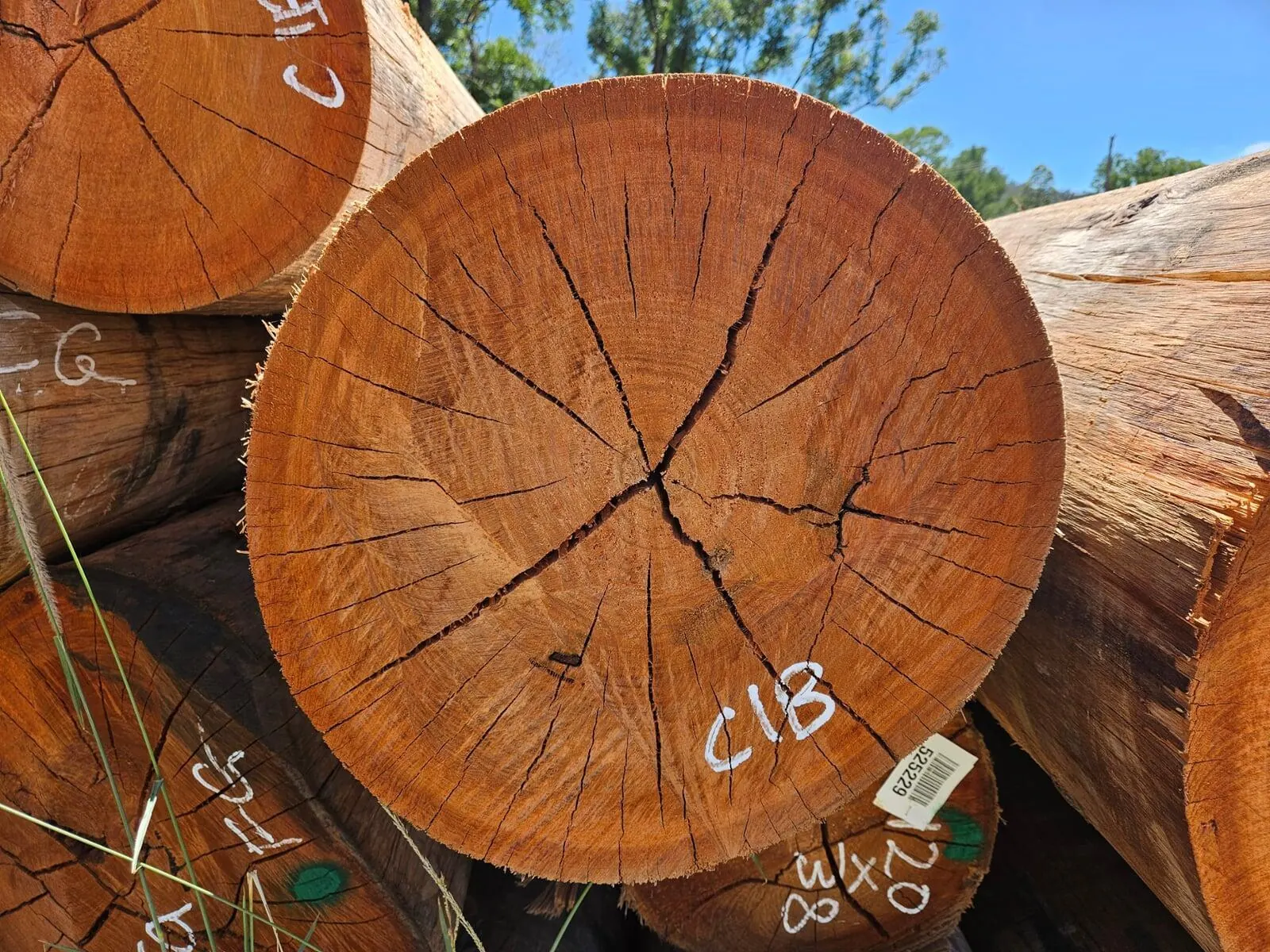
Think of timber as a bundle of straws. Vessels run up and down the tree carrying water and nutrients, surrounded by fibres that give the wood its strength. From the outside in, a tree has:
- Bark: the protective outer layer.
- Cambium: where nutrients travel up and down.
- Sapwood: the outer, living wood. Lighter in colour and usually thinner in hardwoods.
- Heartwood (truewood): the inner wood, made of dead cells plus gums and resins. Darker, and the source of natural durability.
- Pith: the centre core.
Why sapwood matters for treatment
Only sapwood can be effectively penetrated by preservative treatment, in hardwoods and softwoods alike. Even a Class 1 hardwood has sapwood that counts as non-durable (Class 4). Australian Standards limit non-durable sapwood to 20% of the cross-section in structural applications.
Moisture content and movement
A living tree is full of water. Freshly cut timber is "unseasoned"; as it dries it becomes seasoned timber, which is typically 10–15% moisture content.
How timber shrinks
Timber shrinks very little along its length, but significantly around the growth rings (tangentially) and across them (radially). That is why the cut matters. Quarter-sawn timber is cut along the growth rings and stays flatter and more stable, but costs more and can be harder to source. Back-sawn timber, the most common cut, tends to cup as it dries.
Equilibrium moisture content
Timber settles at a moisture content that matches its surroundings, and it changes daily and seasonally: it swells in wet weather and shrinks on hot, dry, windy days. For decking and flooring, let the timber acclimatise for a few weeks where it will be installed, avoid doing this in unusually wet or dry spells, and always check moisture content before installing. Our timber care guide covers looking after it afterwards.
Sawn and engineered products
Sawn and round timber
- Round timber: debarked, treated logs for poles, bridges and pole houses.
- Sawn timber: quarter-sawn for stability, or back-sawn (most common, more prone to cupping).
Engineered timber
- LVL (laminated veneer lumber): 2.5–4 mm veneers peeled from logs and glued with the grain running the same way. Straight and stable; now used even for wall studs.
- Glulam (glued laminated timber): timber pieces glued into large beams. Beams can be pre-cambered so they straighten under load, which helps on long spans.
- I-joists: timber flanges with an OSB or plywood web. Never cut the flanges, and only drill the web within the manufacturer's limits.
- CLT (cross-laminated timber): layers laid in alternating directions to make large slabs for floors and walls, lifted into place by crane.
Panel products
Plywood (veneers at 90 degrees), particleboard, MDF, hardboard, OSB (oriented strand board) and decorative veneers each suit different jobs, from flooring and bracing to cladding and joinery.
Adhesives
LVL, structural plywood and exterior products use phenol formaldehyde adhesives, which are stable and long-lasting. Some interior plywood uses urea formaldehyde, which is less stable. Products made to Australian Standards use adhesives designed to be safe and durable for the life of the product.
Sizing and ordering
- Unseasoned (green) hardwood is usually ordered by nominal size (for example 100 × 50 mm), with allowance for shrinkage.
- Dry timber is usually ordered by actual finished size.
- In Australia, depth comes first, then breadth: studs and joists 90 × 35 or 90 × 45 mm; plates and battens laid flat 45 × 70 mm; standing joists 190 × 35 mm.
| Type | Common sizes (mm) |
|---|---|
| Dry pine | 70 × 35/45, 90 × 35/45, 140 × 35/45, 190 × 35/45 (some suppliers 120 and 170 deep) |
| Seasoned hardwood | 90 × 35/45, 140 × 35/45, 190 × 35/45 (170 less common) |
| Unseasoned hardwood | 50 × 50; joists 125 × 50 and 150 × 50 (traditionally 4 × 2" and 6 × 2") |
We supply to order, including custom sizes and profiles.
Structural and appearance grading
Structural timber is graded in two main ways. Either way, a lower number means weaker timber and a higher number means stronger timber.
- F-grade (stress grade): visual grading by trained graders, who check more than 20 natural characteristics such as knots, slope of grain, gum veins, checks, splits and distortion. The grade combines the species' strength group with the structural grade of the piece.
- MGP (machine graded pine): timber passes through rollers and its deflection under load sets the grade (MGP 10, 12 or 15). MGP 10 is roughly F5 and usually contains heart; MGP 12 is roughly F7 and usually free of heart, so it is less prone to checking and splitting at connections.
F-grades on our poster
Our poster lists stress grades from F4 (~4 MPa) to F34 (~34 MPa). F14 or higher is recommended for decking, joists and bearers. Examples: Cypress Pine F7, Merbau F11–F14, Spotted Gum F11–F17, Red Ironbark F17–F27. See the full table in F rating: stress grade.
Marking and age
- Graded timber must carry ink stamps, tags or stickers. Don't rely on mill colour marks. If there are several grade marks, use the lowest.
- A grade applies when the timber is graded. Damaged, re-sawn or altered timber loses its stress grade and must be re-graded or treated as non-structural.
- For heritage buildings over 100 years old, consider dropping one F-grade to allow for age.
Appearance grades
- Hardwood: Select (very clean; tiny knots and pinholes only), Medium Feature, High Feature.
- Softwood: Clear, Appearance, Select, Standard, Utility.
- Strength is not appearance. An F17 piece can have large knots or cracks. If it must look good and be strong, specify both grades.
- Terms like "feature grade" or "colonial grade" have no standard meaning. Ask for a written description.
Engineered products and recycled timber
Glulam is graded GL8, GL15, GL17 and so on. LVL and I-beams have no standard grades in Australian design codes; each manufacturer sets its own, so never swap brands without checking the data sheet. Recycled timber has its own grading system so it can be safely reused.
Where to find the standards
Strength groups and grading rules are in AS 2082, AS 2878, AS 1720 and AS 1684. Many interim grading standards are free on the WoodSolutions website; full standards are sold by SAI Global.
Identifying species
Some species are easy to recognise: Cypress has an unmistakable smell, and Spotted Gum and Blackbutt have recognisable colours. Others, such as the different pines, are hard to tell apart even for experienced people. With thousands of species in use, visual identification isn't reliable.
To be certain, send a sample to a laboratory, which examines it under a microscope and runs burn tests. It is common for samples from one site to turn out to be several different species. We supply species verification documents with our timber; see delivery documents.